Digital workers for the jobs your team does by hand
FirstCoast.ai builds custom AI agents that answer customers, handle back-office work, and put your company's knowledge one question away. They run inside the tools you already use and hand anything uncertain to a human.
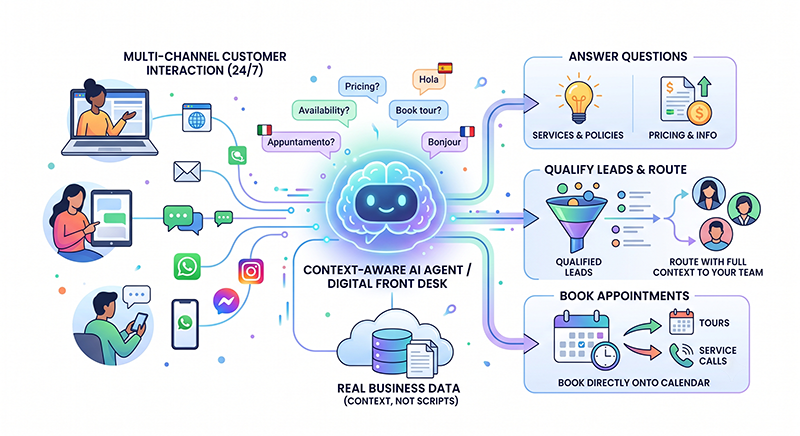
Customer-facing agents
A trained digital front desk on your website, and anywhere else your customers reach you. Context-aware conversation from your real business data, not a rigid script.
- Answer questions about services, pricing policy, and availability, day and night
- Qualify leads and route the good ones to your team with full context
- Book appointments, tours, and service calls straight onto your calendar
- Meet customers where they are: web, email, SMS, WhatsApp, Instagram, Messenger
- Serve customers in their own language
Back-office agents
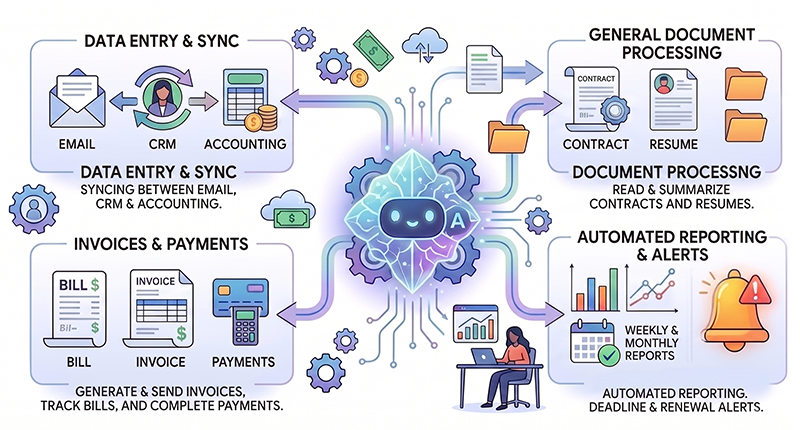
A digital co-worker for the grunt work between systems.
- Data entry and syncing between email, CRM, and accounting
- Document processing: read, summarize, and route invoices, contracts, and resumes
- Automated weekly and monthly reporting across departments
- Deadline, renewal, and follow-up alerts before things slip
- Invoicing and payment links through Stripe or Square
Knowledge agents
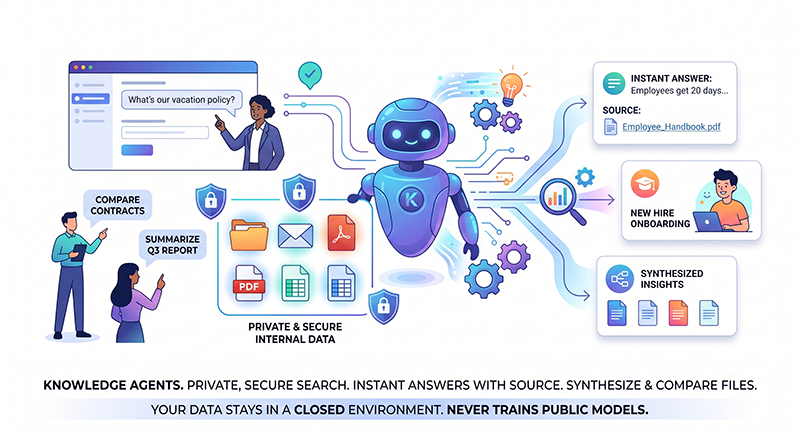
A private, secure search engine over your own documents: emails, PDFs, spreadsheets, and shared folders. Ask in plain English, get the answer with the source.
- "What’s our policy on X?" answered instantly, with the document it came from
- New hires ramp faster by asking the agent instead of interrupting the team
- Compare contracts, summarize reports, synthesize across files
- Your data stays in a closed, private environment. It never trains public models.
Built modular, on purpose
Agents are assembled from skills: knowledge retrieval, scheduling, software integration, data transfer, invoicing, and more. Start focused on two or three tasks, prove the value, then add skills without a rebuild. Skills connect to your software through custom, secured connections and get tested in an isolated environment before they touch production.
How implementation works
Three phases, each with a clear exit. You know what you are getting before the next one starts.
Discovery Audit & planning
Evaluate your processes, meet the team, review how your data is structured, and deliver the blueprint.
Modular build & testing
Build the agents the blueprint calls for, connect your data, and test rigorously in an isolated environment before anything goes live.
Secure deployment & support
Deploy to production, train your team, and hand off to a managed plan that monitors, tunes, and updates the system.
Questions we get asked
Will an AI agent replace my employees?
No. It replaces tasks, not people. An agent handles the repetitive work, answering the same questions all day, entering the same data between systems, chasing the same follow-ups, so your team spends their time on the judgment calls and relationships an agent should never make alone. Every agent we build hands off to a human the moment it hits something it cannot answer with confidence, by design, not as a limitation we are working around.
Does it have to live on my website?
No. Agents deploy wherever your customers already are: your website, email, SMS, WhatsApp, Instagram, Messenger, or a secure standalone page with a shareable link if you don't have a site at all. The agent itself does not change between channels, only where it shows up, so a lead who starts a conversation over text and finishes it on your website is still talking to the same context-aware agent, not two disconnected bots. Pick the channels your customers actually use and we deploy there.
How safe is my data?
Your files stay in a closed, private environment, isolated per client, with no shared access between one client's data and another's. Nothing you give an agent (documents, conversations, records) is ever used to train outside models, including the providers whose models we build on top of. Access is scoped to exactly what each agent needs to do its job, not a blanket connection to everything in your systems.
Do I need new software?
No. Agents integrate with your existing setup in the background: your CRM, your inbox, your calendar, your files, whatever you already run day to day. Software compatibility gets checked during the Discovery Audit, before you commit to anything, so you know upfront whether a connection is straightforward or needs custom work. Even older or less common systems can usually be bridged with a direct integration, so replacing what already works is rarely the answer.
How long until results?
Often weeks, not months, for the first agent. We start with the quickest win identified in your Discovery Audit, not the most ambitious one, so you see a working system fast rather than waiting on a long build before anything ships. From there it is three phases: discovery and planning, a modular build tested in an isolated environment before anything touches production, and a secure deployment with a managed plan behind it, each with a clear exit before the next one starts.
Do I need to be technical?
No. Using an agent day to day is as easy as texting or filling out a form, and training on your specific setup is included in every build, not sold as an add-on later. Your team learns how the agent behaves, what it can and cannot do, and how to hand something to a human when the agent flags it, before it ever goes live for your customers. If your team can use email, they can use this.
What maintenance is involved?
Low. Your side of it is keeping source documents current: update the policy, the price list, or the FAQ you already gave the agent, and it stays accurate without a developer touching anything. A managed plan handles the rest: monitoring for errors, tuning responses as your business changes, and applying updates as the underlying models improve. Most clients spend a few minutes a month on their half of it.
Find your first agent
Two minutes with the AI Opportunity Survey tells you where an agent pays off fastest in your business.